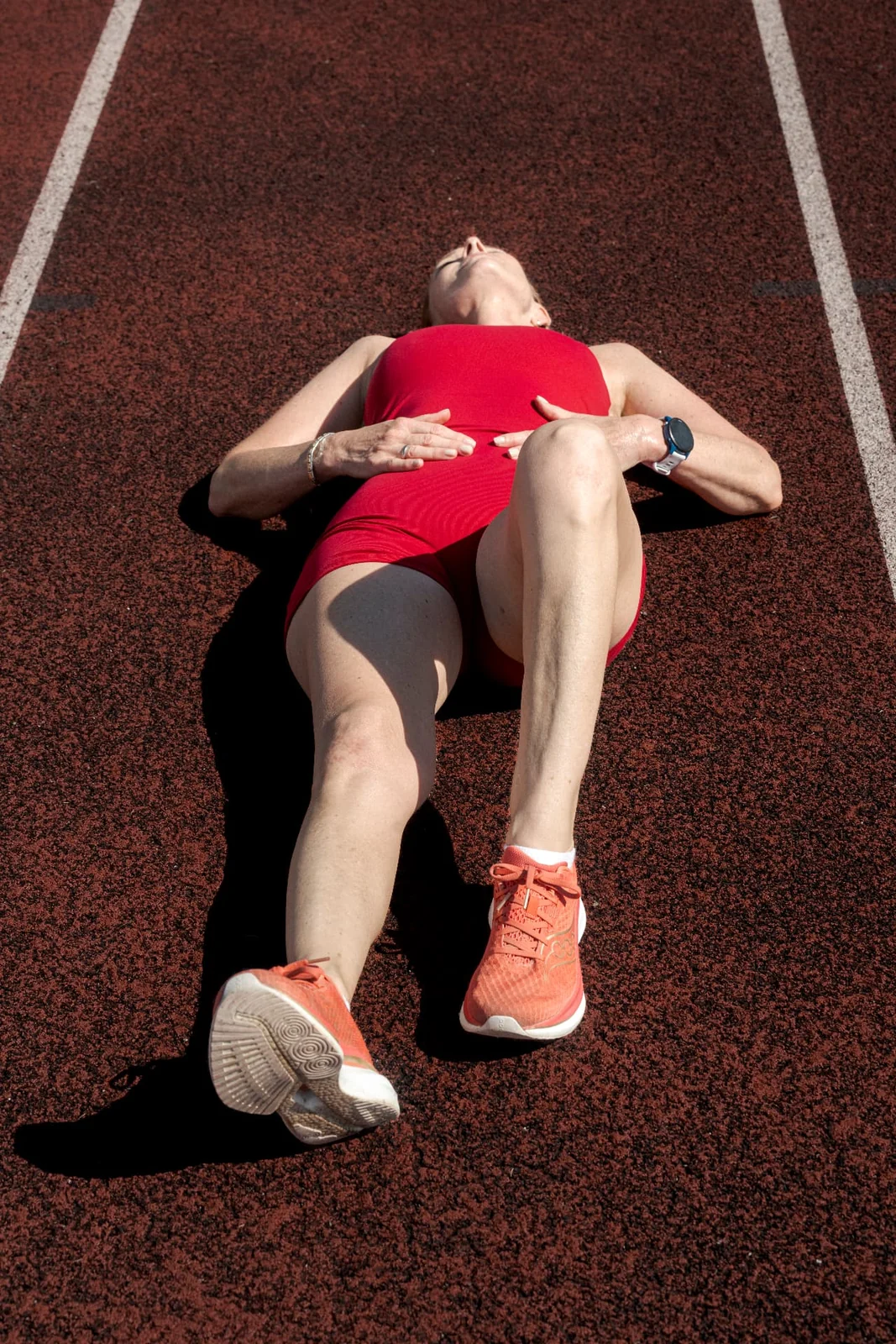
Birgit Pfeifer is lying in the middle of the running track.
Red running dress, orange shoes, the sun above her. The white lines pass by her body. For a moment, nothing happens.
No movement. No speed. No time.
A strange image for a story about running.
Perhaps that is exactly why it is the right one.
Because when we planned this shoot, I was not interested in how to photograph a runner as dynamically as possible. There are millions of those images.
I was interested in something far more difficult to photograph.
What makes a person start running again and again?
For Birgit, the answer begins 18 years ago.
It began with a disaster.
That is how she describes her first five-kilometre run at the Liesinger Herbstlauf.
The idea was wonderfully simple: just run along, be part of it.
Then the others came.
The young ran past. The older ran past. It felt as if everyone ran past.
One might conclude at this point that running is perhaps not the right sport.
Birgit drew a different conclusion.
“That was when the fire was ignited.”
She wanted to become fitter. More enduring. And she wanted to know what was possible.
Occasional running turned into structured training. She completed a running coach certification, worked for years at the Österreichischer Frauenlauf and progressed from five kilometres to the marathon.
18 years later she still stands at starting lines.
Perhaps that is already the most interesting definition of passion.
Not how enthusiastically something begins.
But how long it remains.
The starting line stays the same. The person in front of it does not.
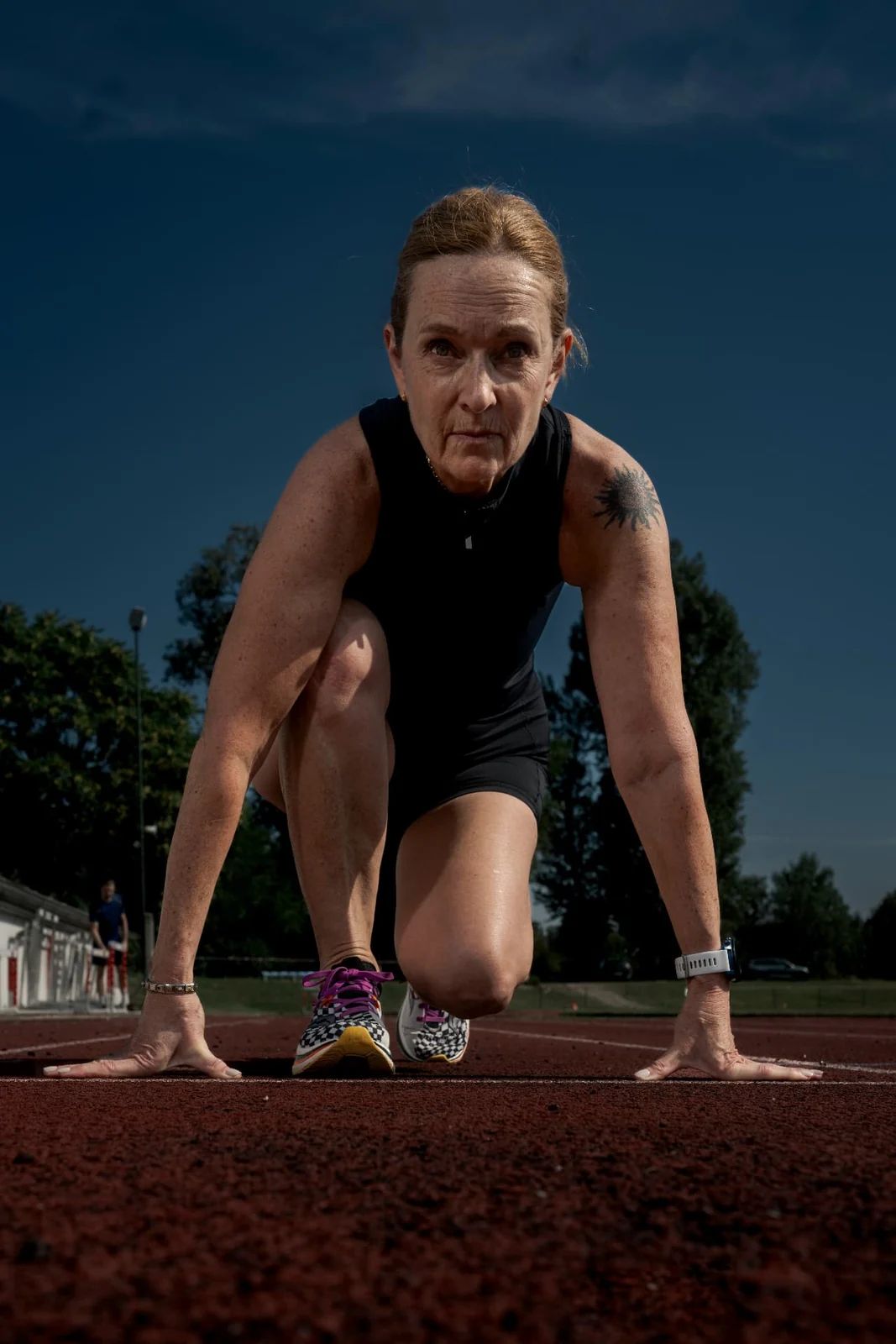
I ask Birgit to get into the starting block.
Not for a competition. For a picture.
Hands on the track, body tensing, gaze forward. For a moment everything is focused on what comes next.
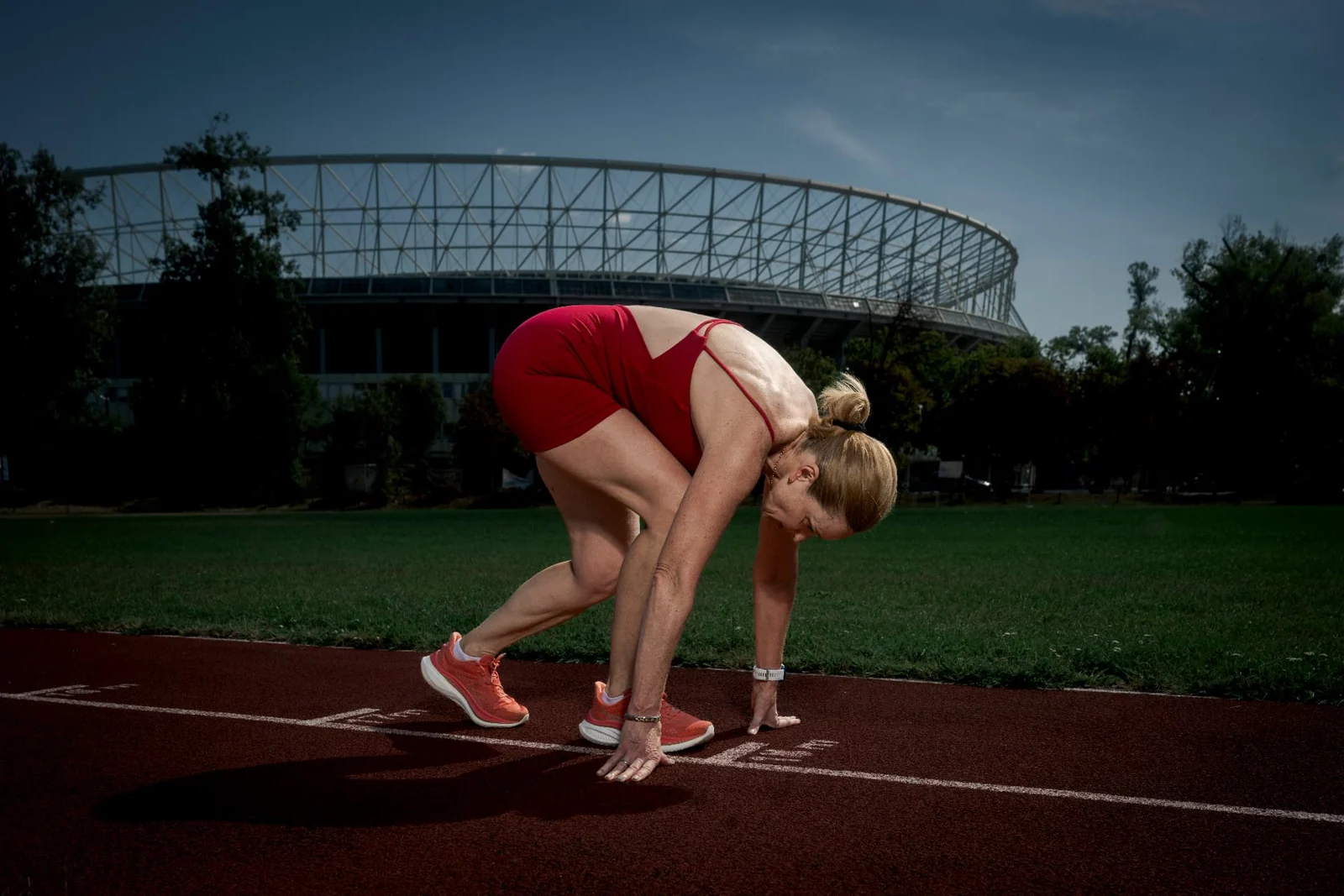
This split second before the start fascinates me.
Nothing is decided yet.
Perhaps there is a parallel to Birgit's story.
Because 18 years of running do not mean 18 years of success.
They also mean Achilles tendon problems. A broken foot. Times when running was only possible to a limited extent.
Birgit talks about it without much drama.
“Giving up was never an option.”
When one goal was no longer reachable, another had to be found.
Through her club ProTeam Vienna, track running entered her life. The long-distance runner became an athlete who suddenly also started over 100 metres – and over many distances in between, up to 5,000 and 10,000 metres.
And once again there was something she did not yet have.
Championship medals.
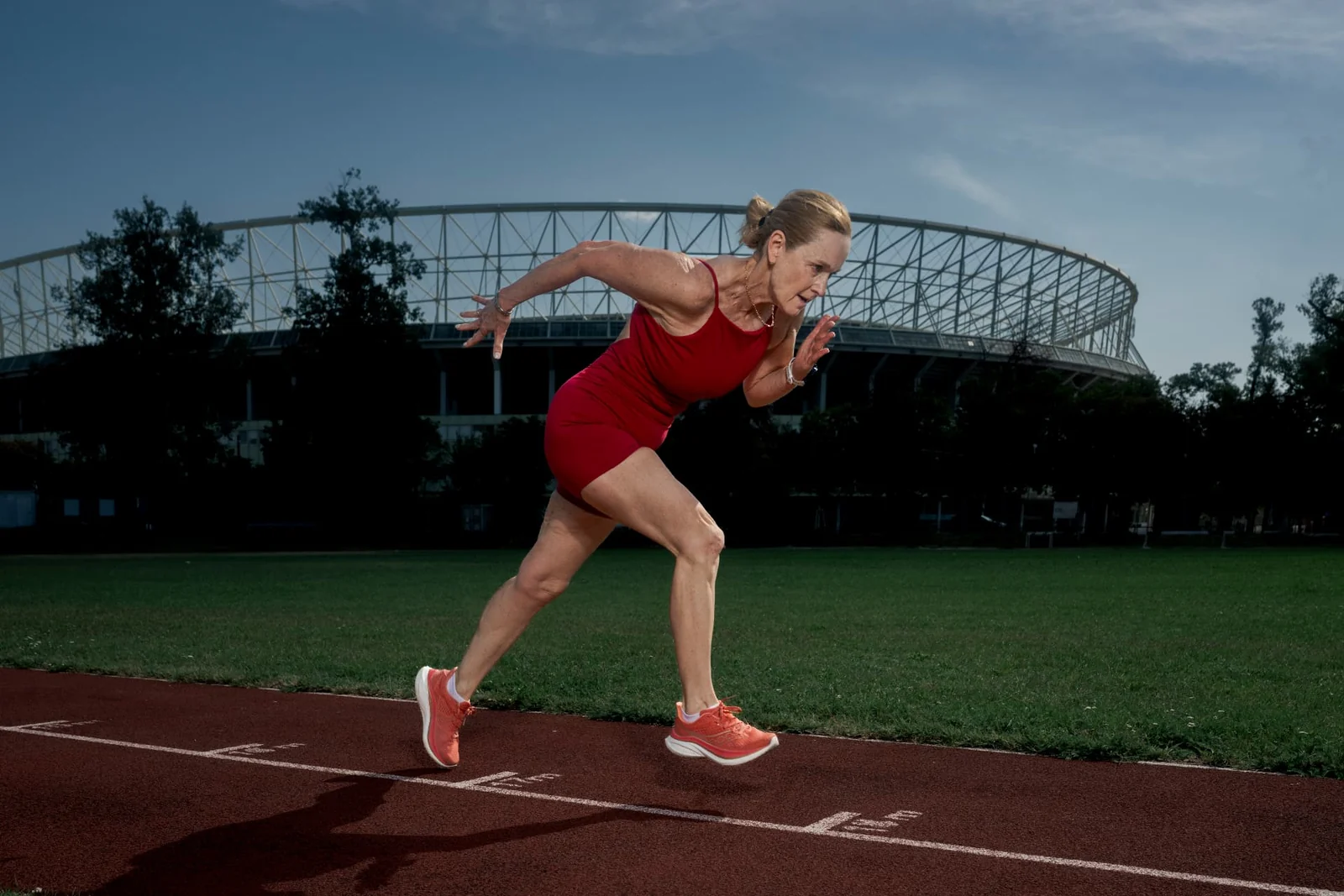
So she ran towards them.
Success is usually only visible at the end.
2026 became a special year.
At the Austrian Masters Indoor Championships, Birgit won silver once and bronze three times, according to her own account.
In May another highlight followed on the track: Over 10,000 metres, Birgit won the W60 category of the Vienna Championships for ProTeam Vienna in 57:36.44 minutes – a personal best.
The Vienna Summer Running Cup was also part of her season; Birgit reports a clear victory in her age group. A few days before our shoot, another age-group victory followed at the Babenbergerlauf.
These are the facts.
They tell remarkably little about how success arises.
A results list knows nothing of a training session on a cold morning. It knows nothing of inner resistance, no injury and no day when the sofa seems more convincing than the running shoes.
It knows only start number, time and placing.
Perhaps that is why what happens between those numbers interests me far more.
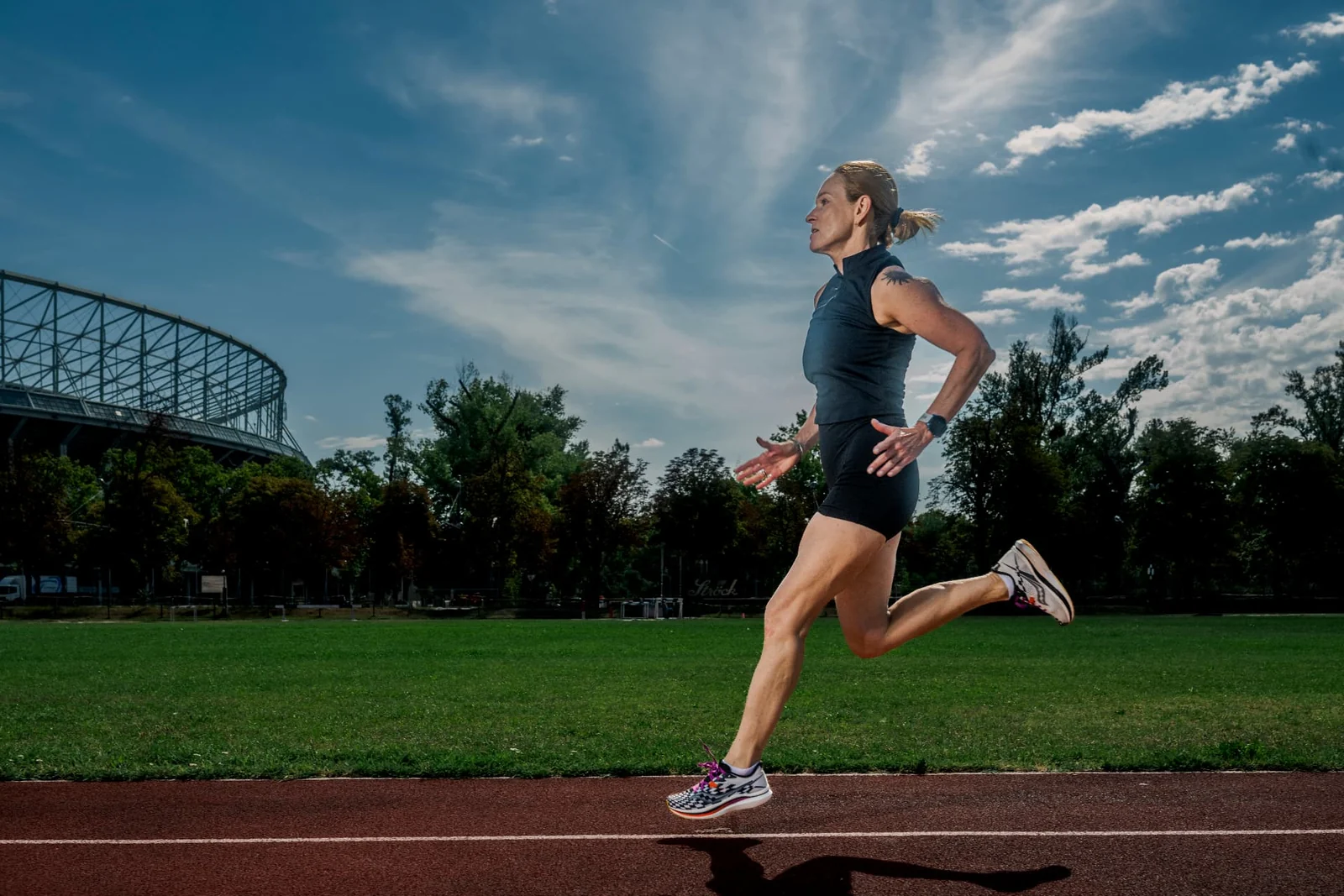
Of course we also photograph movement that afternoon.
Birgit runs.
Again and again.
But I quickly notice: the images become interesting when they do not simply explain what she is doing.
But let us sense something of what it means to her.
What does passion look like?
At some point that became the real question of this shoot.
And with it, the track changed.
It was no longer merely the place where we photographed.
It became part of the image.
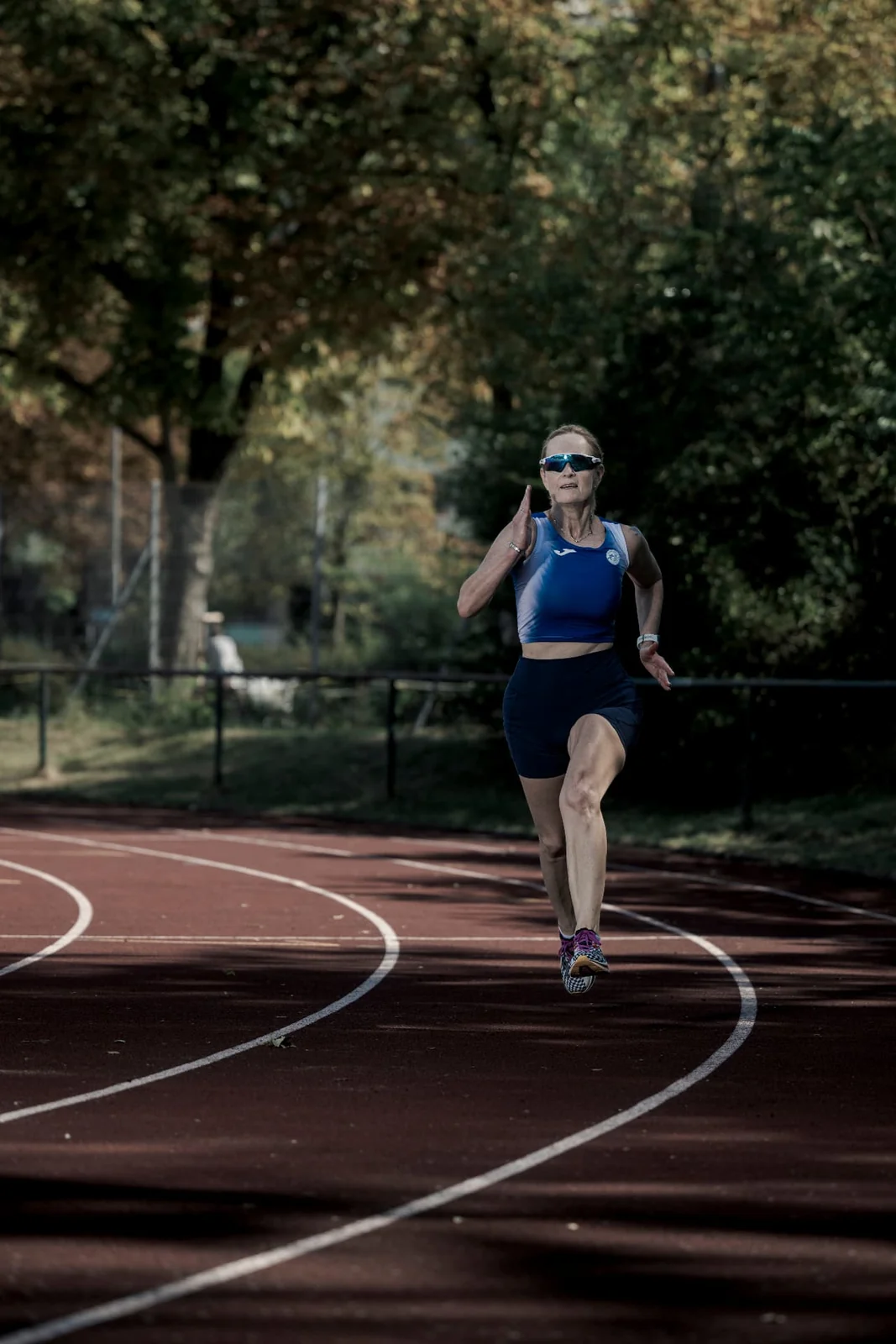
The white lane markings draw curves through the composition. The red surface becomes a field of colour. The sky gains space. Elsewhere we let the surroundings almost completely disappear into darkness.
Sometimes I am very close to Birgit with the camera.
Then so far away that the athlete appears small within the geometry of the track.
We photograph from below.
From above.
In motion.
In the starting block.
And sometimes we do something that initially seems completely absurd for a running shoot:
nothing at all.
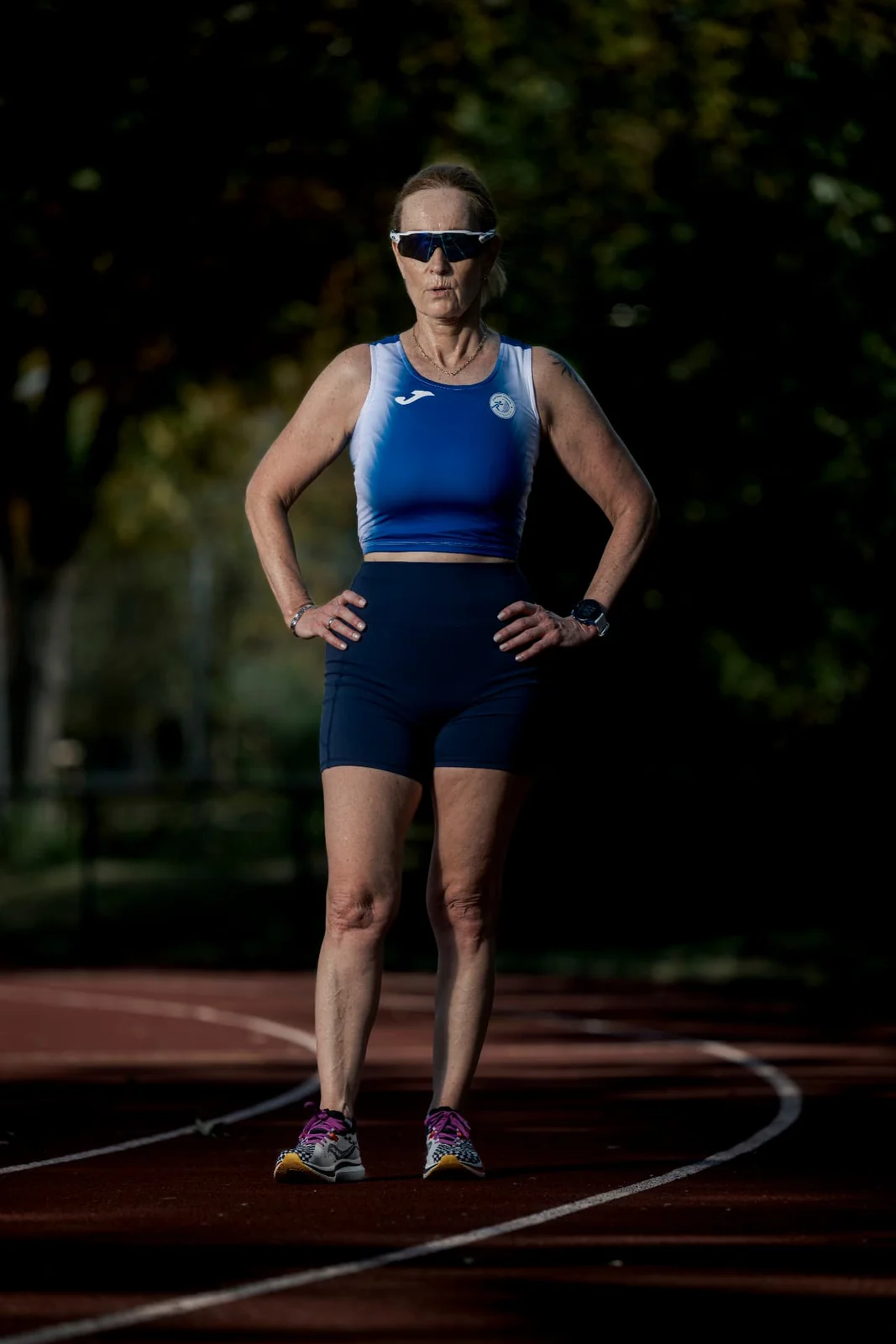
Birgit stands in the light.
The rest is allowed to grow dark.
No movement has to prove that she is a runner.
You see it anyway.
Perhaps that is the point where, for me, an athletic portrait differs from classical sports photography.
The decisive question is no longer:
Did we capture the perfect running stride?
But:
Does this image tell us something about this person?
And suddenly stillness becomes more important than speed.
Birgit sits on the track.
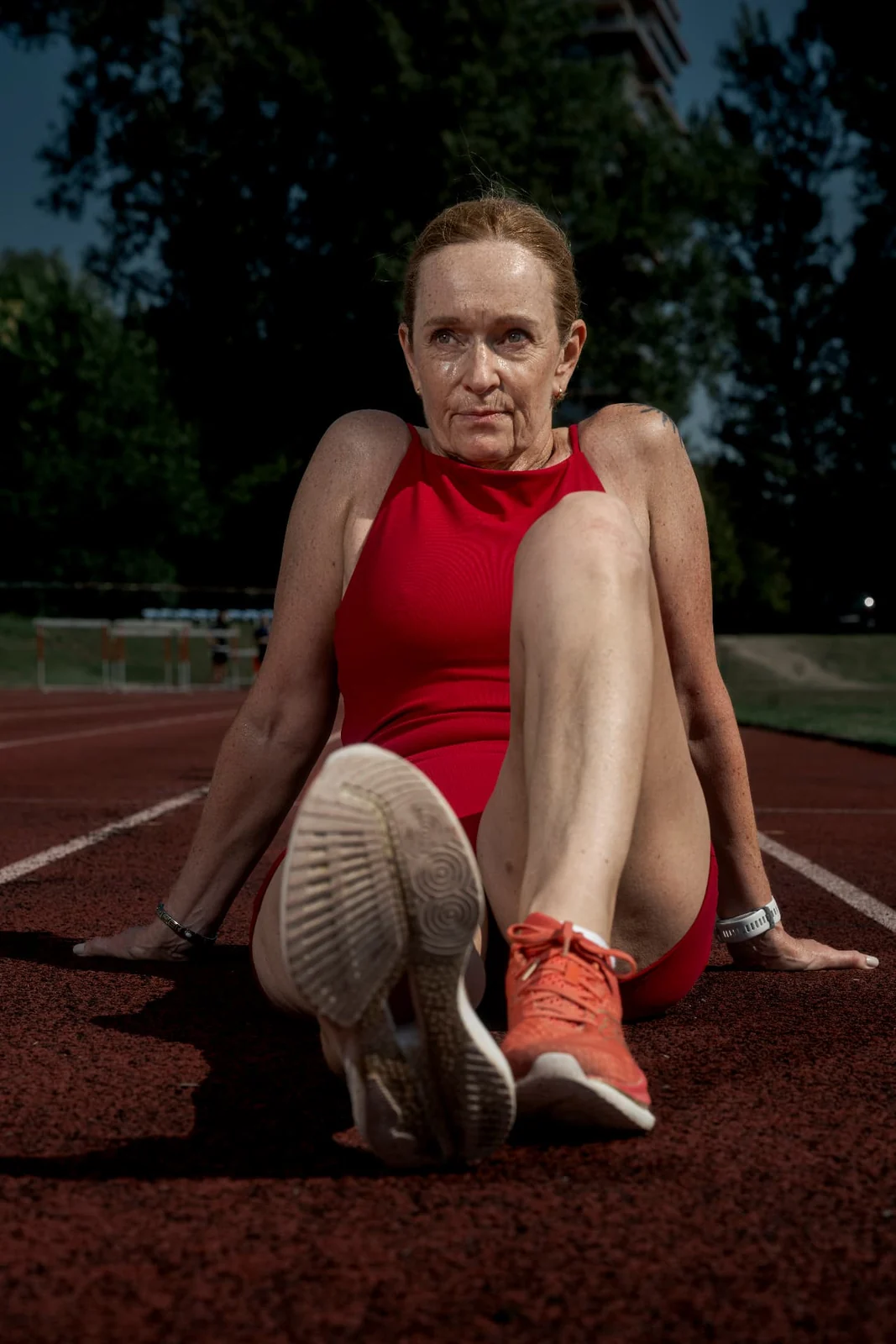
A few minutes earlier she was still running for us. Now she rests.
I like this image precisely because of that.
Because passion does not consist solely of spectacular moments.
Most of the time it looks far more unremarkable.
Repetition.
Training.
Consistency.
And sometimes simply the decision to do something today even though it could just as easily be postponed until tomorrow.
Birgit knows these moments.
Of course, she says, she too knows the comfort zone.
But twice a week there is also strength training. Not because motivation knocks on the door every morning.
But because she makes a clear distinction:
“Motivation is important, but discipline is the key.”
Perhaps that is exactly the connection between sport and photography that increasingly interests me that afternoon.
The extraordinary results rarely arise in the extraordinary moment.
They arise through everything that has been done repeatedly before.
At some point it is no longer about running away from someone else.
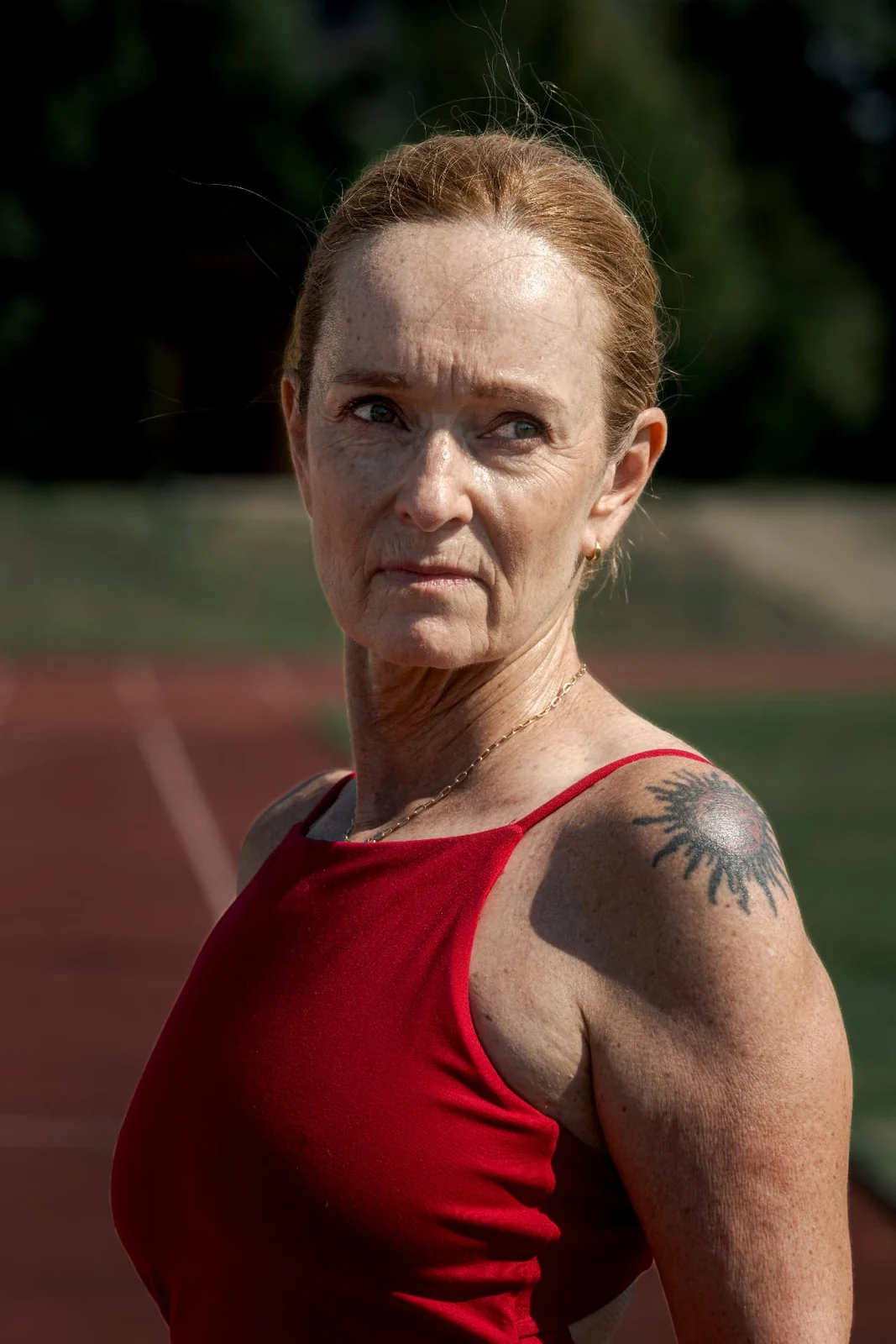
Birgit looks straight into the camera.
No running.
No pose suggesting speed.
Just a portrait.
And perhaps this image tells more about success than some finish-line photo.
Birgit is happy about her medals. Of course.
But when she talks about why she still runs today, a different sentence comes quite quickly:
“In the end it is above all about staying fit and mobile.”
And then another one:
“Running clears the head and remains my great passion.”
With that, the meaning of success changes too.
It is no longer exclusively about being faster than someone else.
Success can mean coming back after an injury.
Pursuing a new athletic goal at sixty.
Or still being curious after 18 years about what one's own body can achieve.
Age is not a message.
It is merely a number on the results list.
The medals come at the very end.
Not only in this article.
Also during the shoot.
Birgit takes them in both hands and holds them towards the camera.
Gold. Silver. Bronze. Many years of training suddenly condensed into a few square centimetres of metal.
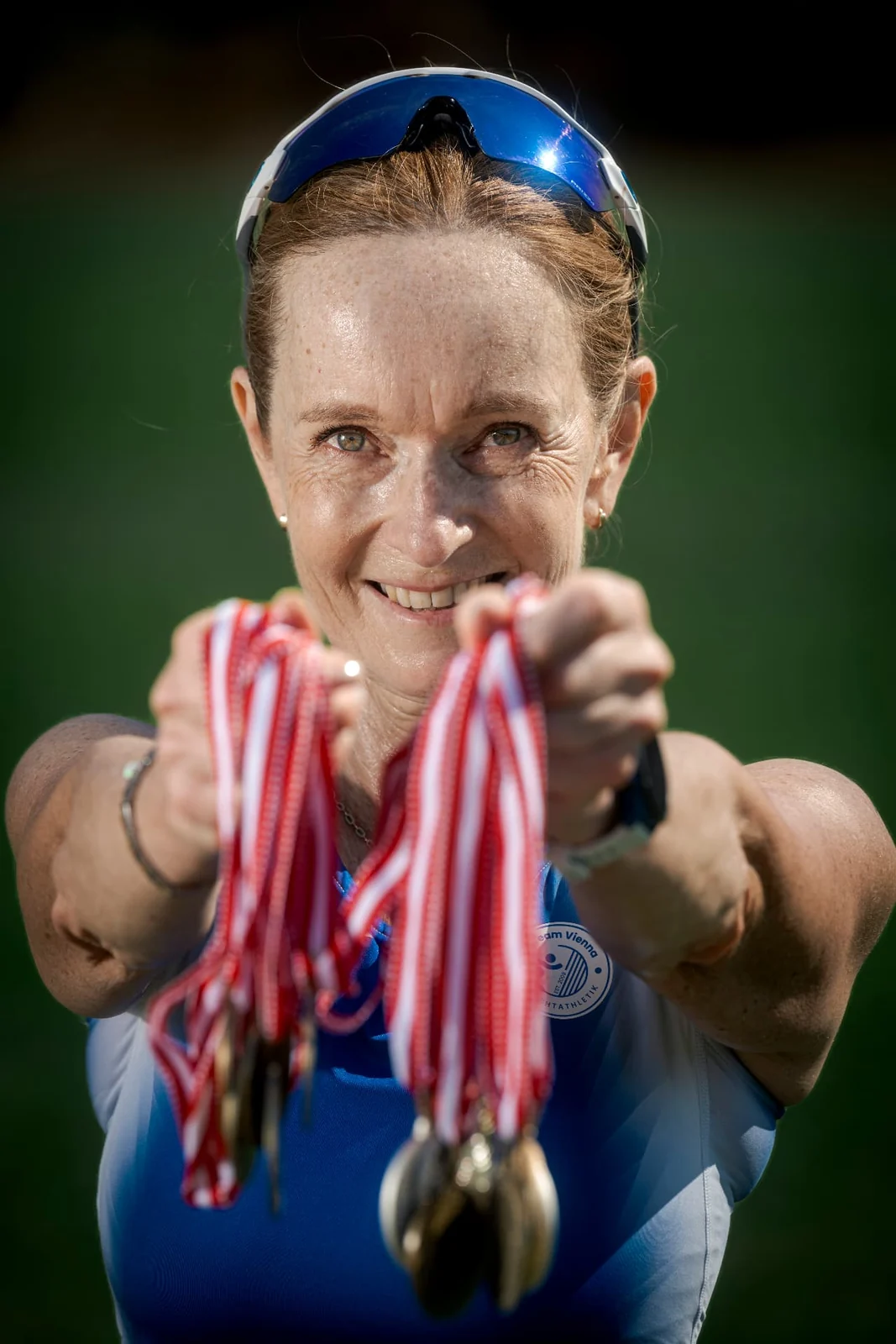
It is probably the most obvious image of our entire series.
And at the same time one that turns the story on its head.
Because now we finally see the success.
Only the path there we do not see.
None of these medals tells of that first five-kilometre run when Birgit was overtaken by everyone.
None of the Achilles tendon.
None of the broken foot.
None of the strength training.
None of the countless kilometres.
And none of the decision to do it again tomorrow.
Perhaps that is why we need stories.
And perhaps we need photographs that try to do more than freeze a sporting moment correctly.
What remains of what drives us?
Every runner knows their times.
Kilometres.
Personal bests.
Start numbers.
Perhaps there are certificates, trophies and eventually a box full of medals.
But passion is harder to store.
That is exactly why I wanted to make these images.
Not as classical sports reportage.
Not as a collection of perfect running movements.
But as a portrait of a person and of something that has belonged to her life for 18 years.
Fine Art, to me, does not mean making reality artificially more beautiful.
It means using light, perspective, colour, space and the right moment so consciously that an image tells more than the obvious.
A running track becomes a stage.
Movement becomes form.
Stillness becomes tension.
And a sports shoot becomes a personal story.
At the end of her running report Birgit wrote a sentence that has stayed in my mind ever since.
“You are never too old to begin.”
But actually the part immediately before it is even more important.
Not tomorrow.
Today.
18 years ago Birgit did exactly that.
She started running.
And she is still running.
Birgit Pfeifer / The Art of Running
Birgit Pfeifer · Runner · ProTeam Vienna
Vienna · 2026
Photography · Peter Scholz / SCHOPHO
Behind the Lens
Not just what you do.
But why you keep doing it.
Behind the Lens
Every photograph has a story behind it.
The Journal explores the people, ideas and decisions behind the images.